There was once a farmer who believed he had mastered the art of growing crops.
He didn’t just grow wheat or rice. He experimented. He combined seeds, layered techniques, used irrigation systems, and built complex farming methods that promised higher yields.
For years, his farm flourished.
But one season, everything failed—spectacularly.
This is not just a story about farming.
It is the story of modern finance.
🌾 The Beginning: Simple Seeds
In the early days, the farmer worked with simple seeds—pure and understandable.
- Wheat
- Rice
- Vegetables
In financial markets, these are your basic products:
- Stocks
- Bonds
They are transparent. You know what you’re growing. You understand the risks.
If the weather turns bad, you expect some loss—but nothing catastrophic.
🌿 The Tools: Managing Risk
As the farmer grew smarter, he began using tools:
- Irrigation systems
- Fertilizers
- Storage techniques
In finance, these are derivatives:
- Options
- Futures
- Swaps
They don’t create crops themselves—but they help manage risk.
For example:
- A futures contract is like locking in the price of your harvest
- An option is like buying insurance on your crops
Used wisely, these tools make farming safer.
🌳 The Innovation: Combining Crops
Then came innovation.
The farmer started combining crops to create new products:
- Hybrid seeds
- Packaged food
- Processed goods
In finance, this is the birth of structured products.
Imagine:
- Part of your land grows safe crops (like bonds)
- Another part grows high-risk, high-reward crops (like options)
Together, they create a balanced harvest:
- Protection + upside
This was brilliant.
Or so it seemed.
🌪️ The Overconfidence: Complex Farming
The farmer became ambitious.
He didn’t just grow crops—he built systems on top of systems:
- Bundled harvests from multiple farms
- Packaged them into premium products
- Sold them to distant buyers
In finance, this looked like:
- Mortgage-Backed Securities (MBS)
- Collateralized Debt Obligations (CDOs)
These were no longer simple crops.
They were layers of products, each hiding what lay beneath.
🌱 The Weak Seeds: Subprime Mortgages
At the root of everything were the seeds.
But this time, the farmer made a mistake.
He started planting low-quality seeds:
- Weak soil
- Poor screening
- Overconfidence in growth
In financial terms, these were subprime mortgages—loans given to borrowers who might not repay.
Individually, these seeds didn’t look dangerous.
But they were.
🌾 The Bundling: Hiding the Quality
The farmer bundled crops from many fields together.
Good crops mixed with bad ones.
This became:
👉 Mortgage-Backed Securities (MBS)
Now buyers couldn’t tell:
- Which crops were healthy
- Which were rotten
Risk was no longer visible—it was hidden inside bundles.
🌳 The Packaging: Creating Illusions
Then came another layer.
The farmer took these bundles and repackaged them again—labeling them as premium products.
This became:
👉 CDOs (Collateralized Debt Obligations)
He sliced them into:
- Safe portions
- Risky portions
And somehow, even risky crops were labeled “safe.”
The illusion was complete.
🔥 The Insurance: Selling Protection
To make things even more attractive, the farmer introduced insurance:
“If your crops fail, I’ll pay you.”
This was:
👉 Credit Default Swaps (CDS)
But there was a problem.
He sold insurance:
- Multiple times
- On the same crops
- Without enough reserves
It was like insuring the same field again and again—without the ability to pay if disaster struck.
🔗 The Network: Everything Connected
Now farms were no longer independent.
They were connected:
- Through irrigation
- Through contracts
- Through dependencies
In finance, this was the OTC derivatives network:
- Swaps
- CDS
- Interbank exposure
If one farm failed, others would feel the shock.
🌪️ The Storm: 2008
Then came the storm.
Housing prices fell.
And suddenly:
- Weak seeds failed (borrowers defaulted)
- Bundles lost value (MBS collapsed)
- Packaged products failed (CDOs crashed)
- Insurance claims surged (CDS exploded)
- Institutions collapsed (Lehman, AIG)
- The entire system froze
What seemed like a flourishing ecosystem was actually fragile.
🌾 The Real Lesson of Stock Farming
The farmer realized too late:
- He had lost track of his seeds
- He trusted complexity more than quality
- He believed packaging could replace fundamentals
🌱 What Investors Must Learn
A wise investor—like a wise farmer—should:
- Understand what they are investing in
- Avoid blind complexity
- Diversify carefully
And most importantly:
⚠️ Understand the trade-off of complexity
Advantages:
- Customization of returns
- Risk transfer
- Enhanced yield
Risks:
- Hidden exposure
- Model dependency
- Liquidity issues
- Systemic collapse under stress
🌾 Final Thought
In farming, no matter how advanced the system becomes, everything still depends on the quality of the seed.
In finance, it’s the same.
👉 If the foundation is weak, no amount of structuring can save the system.
Because in the end:
**You cannot engineer your way out of bad fundamentals.:::
Great—let’s tighten this into a clear hierarchy + farming analogy + hedging flow so you can use it directly in your blog.
🌾 Where do “layered products” like equity options sit?
🧠 Quick placement
- Equity option → Derivative (tool layer), not fully “structured”
- Basket/index option → Multi-asset derivative (a bit more layered)
- Structured product → Packaging layer (uses options/swaps inside)
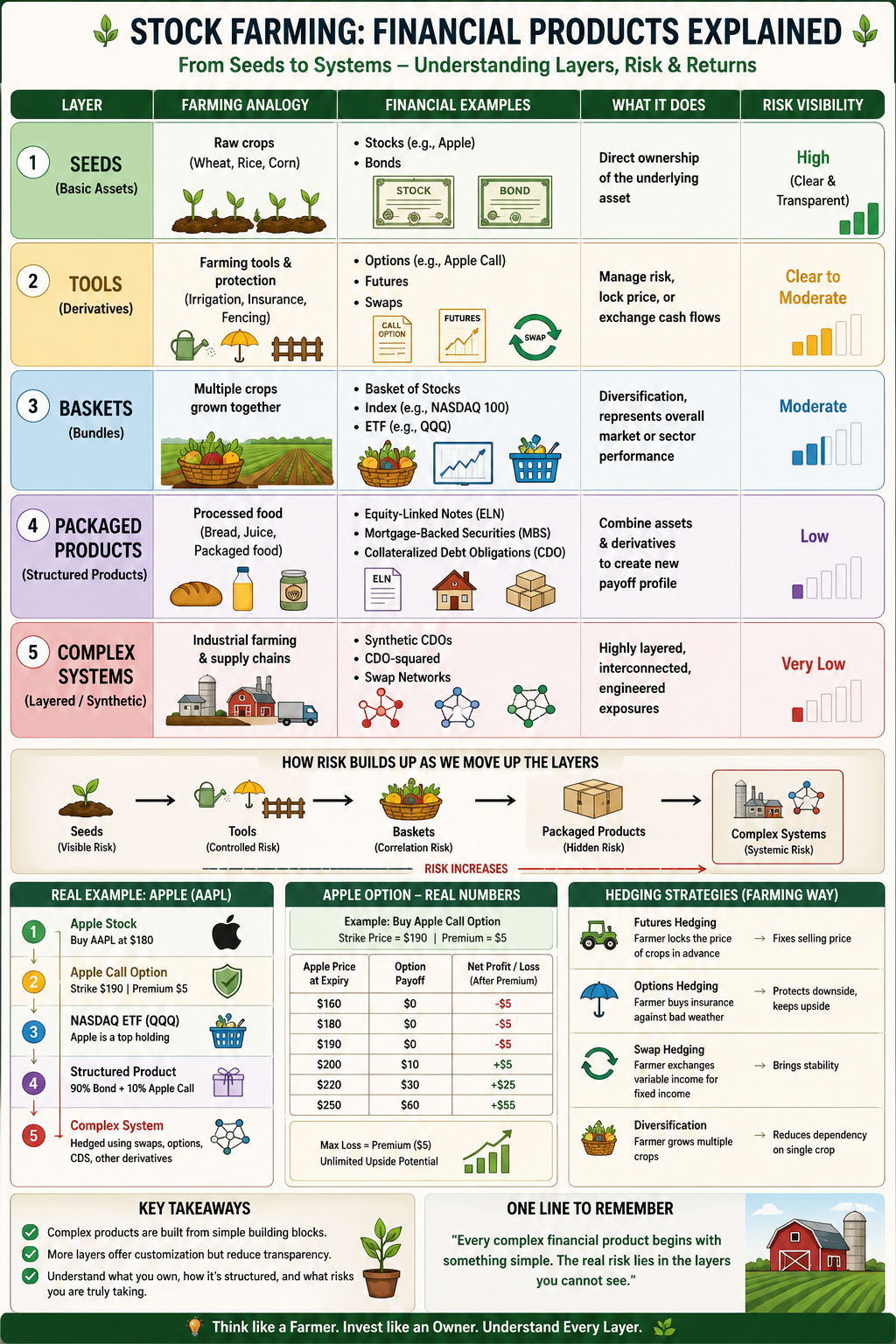
🌱 Product Layers (Farming Order)
| Layer | Farming Analogy | Financial Examples | What it does |
|---|---|---|---|
| 1️⃣ Base | Seeds / Crops | Stocks, Bonds | Raw exposure |
| 2️⃣ Tools | Irrigation, fencing | Options, Futures, Swaps | Manage risk |
| 3️⃣ Bundles | Mixed harvest | Baskets, Indices | Combine assets |
| 4️⃣ Packaging | Bread, juice | Structured products (ELNs, MBS, CDO) | Engineer payoff |
| 5️⃣ Systems | Industrial farming | Multi-layer (synthetic CDOs, swap structures) | Scale + complexity |
👉 Equity options sit in Layer 2 (tools)
👉 They become “layered” only when embedded into Layer 4 products
🌿 How options become part of layered products
Example: Equity-Linked Note (ELN)
- 80–90% → bond (guarantee capital)
- 10–20% → equity call option
👉 Outcome:
- Downside protected (bond)
- Upside from option
➡️ Here, the option is a building block, not the final product
🌾 Hedging Strategies — Explained like Farming
🛡️ 1. Futures Hedging (Price Lock)
🌾 Analogy:
Farmer agrees today to sell crops at a fixed price later
💰 Finance:
Sell futures to lock price
👉 Protects against price fall
☔ 2. Options Hedging (Insurance)
🌾 Analogy:
Farmer buys insurance for bad weather
💰 Finance:
- Buy put option → protect downside
- Keep upside open
👉 Flexible protection
🔄 3. Swap Hedging (Stability)
🌾 Analogy:
Farmer exchanges variable income for fixed income
💰 Finance:
- Interest rate swap
- Equity swap
👉 Convert uncertainty → predictability
🧺 4. Basket Diversification
🌾 Analogy:
Farmer grows multiple crops
💰 Finance:
- Portfolio diversification
- Index exposure
👉 Reduces dependency on one asset
🌱 Hedging Order (VERY IMPORTANT FLOW)
Think like a farmer managing risk step-by-step:
Step 1: Choose crops
👉 Stocks / bonds (base exposure)
Step 2: Protect price
👉 Futures (lock price)
Step 3: Add flexibility
👉 Options (insurance)
Step 4: Stabilize income
👉 Swaps (convert risk)
Step 5: Package strategy
👉 Structured product (combine all)
🔥 Big Insight (for blog)
👉 Options are not “complex products” by themselves
👉 They are tools that create complexity when layered
⚠️ Risk as layers increase
- Layer 1 → visible risk
- Layer 2 → manageable risk
- Layer 3 → diversification illusion possible
- Layer 4 → hidden risk
- Layer 5 → systemic risk
🌾 Blog Line (Strong)
“An option is like a tool in farming—it doesn’t create the harvest, but when combined with crops and systems, it can shape the entire outcome.”
⚡ 10-Second Revision
- Options = tools (Layer 2)
- Basket = grouping (Layer 3)
- Structured = packaging (Layer 4)
- Swaps = connectors (middle layer)
- More layers = more hidden risk
Perfect—let’s make this visual, intuitive, and blog-ready 👇
🌾 📊 FINANCIAL PRODUCTS AS FARMING — VISUAL MAP
🧩 FULL LAYERED DIAGRAM
            🌪️ LAYER 5: COMPLEX SYSTEMS
   (Synthetic products, CDO², swap networks)
                    ↓
            📦 LAYER 4: STRUCTURED PRODUCTS
     (Equity-linked notes, MBS, CDO)
                    ↓
            🧺 LAYER 3: BUNDLES / BASKETS
       (Index, Basket, Portfolio)
                    ↓
            🛠️ LAYER 2: TOOLS (DERIVATIVES)
    (Options, Futures, Swaps)
                    ↓
            🌱 LAYER 1: BASIC ASSETS
        (Stocks, Bonds, Loans)
🌾 🌱 FARMING INTERPRETATION
🌱 Layer 1: Seeds (Base Assets)
- Stocks = crops
- Bonds = stable crops
👉 You directly own the harvest
🛠️ Layer 2: Tools (Derivatives)
- Options → insurance
- Futures → price lock
- Swaps → exchange income
👉 You don’t grow crops here—you manage risk
🧺 Layer 3: Bundles (Diversification)
- Basket → multiple crops
- Index → farm performance
👉 Reduces dependency on one crop
📦 Layer 4: Packaging (Structured Products)
- Combine:
- Crops (stocks/bonds)
- Tools (options/swaps)
👉 Example:
- Bond + option = structured note
🌪️ Layer 5: Complex Systems
- Multi-layer packaging
- Synthetic exposure
- Interconnected contracts
👉 Hard to understand → fragile in crisis
🔍 WHERE DOES EACH PRODUCT SIT?
| Product | Layer | Farming Analogy |
|---|---|---|
| Stock | 1 | Crop |
| Bond | 1 | Stable crop |
| Equity option | 2 | Insurance |
| Futures | 2 | Price lock |
| Swap | 2 | Income exchange |
| Basket | 3 | Mixed crops |
| Index | 3 | Farm performance |
| ETF | 3 | Basket you can buy |
| Structured note | 4 | Packaged food |
| MBS/CDO | 4 | Processed bundles |
| Synthetic CDO | 5 | Industrial system |
🌿 REAL EXAMPLE (STEP-BY-STEP BUILD)
🎯 Goal: Safe + Growth Product
Step 1 (Layer 1)
Buy bond → safe return
Step 2 (Layer 2)
Buy equity call option
Step 3 (Layer 4)
Combine → structured product
👉 Final:
- Downside protected
- Upside from market
🌾 HEDGING FLOW (FARMING ORDER)
1. Grow crops → Stocks/Bonds
2. Lock price → Futures
3. Buy insurance → Options
4. Stabilize income → Swaps
5. Package strategy → Structured products
⚠️ RISK BUILD-UP (VERY IMPORTANT)
| Layer | Risk |
|---|---|
| 1 | Visible (market, credit) |
| 2 | Controlled |
| 3 | Correlation risk |
| 4 | Hidden / model risk |
| 5 | Systemic risk |
🧠 MASTER INSIGHT
👉 Options are NOT complex products
They are:
✔ Simple tools
BUT
👉 When combined → create complexity
🌾 BLOG LINE (STRONG)
“In finance, complexity doesn’t start with products—it starts when simple tools like options are layered on top of assets and packaged into something new.”
⚡ ULTRA-FAST REVISION
- Layer 1 → crops
- Layer 2 → tools
- Layer 3 → bundles
- Layer 4 → packaging
- Layer 5 → system
👉 More layers = more hidden risk
🚀 Great—let’s take it one level higher: a Medium-style blog (SEO-ready) + real numbers (Apple example) + FRM-style case study questions 👇
🌾 Stock Farming in Finance: From Apple Stock to Structured Products
Modern finance looks complex—but at its core, it follows a simple pattern.
Everything begins with a basic asset… and then layers are added.
The more layers you add, the more you change:
- Risk
- Return
- Transparency
To understand this, let’s walk through a real example using Apple (AAPL)—and think like a farmer.
🌱 Step 1: The Seed — Apple Stock (Layer 1)
You buy Apple stock at $180.
- If it rises to $200 → profit = $20
- If it falls to $150 → loss = $30
👉 This is like growing a single crop:
- Simple
- Transparent
- Direct risk
🛠️ Step 2: The Tool — Apple Call Option (Layer 2)
You buy a call option:
- Strike price = $190
- Premium = $5
Outcomes:
- If Apple = $220 → profit = $30 − $5 = $25
- If Apple = $180 → loss = $5 (premium only)
👉 This is like crop insurance:
- Limited loss
- Upside retained
🧺 Step 3: The Basket — ETF Exposure (Layer 3)
You invest in a NASDAQ ETF, where Apple is a major component.
👉 Now:
- You don’t depend only on Apple
- You gain diversification
👉 Farming analogy:
Growing multiple crops instead of one
📦 Step 4: The Packaging — Structured Product (Layer 4)
A bank offers a product:
- 90% invested in bonds
- 10% invested in Apple call options
Outcome:
- If Apple falls → bond protects capital
- If Apple rises → option gives upside
👉 This is like:
Combining stable crops with high-risk crops for balanced yield
🌪️ Step 5: The System — Complex Structures (Layer 5)
Behind the scenes, the bank may hedge using:
- Swaps
- Options
- Other derivatives
👉 Risk is now:
- Distributed
- Layered
- Harder to track
⚠️ What Changes Across Layers?
| Layer | Product | Risk Visibility |
|---|---|---|
| 1 | Stock | High |
| 2 | Option | Clear |
| 3 | ETF | Moderate |
| 4 | Structured | Low |
| 5 | Complex system | Very low |
👉 As layers increase:
- Risk becomes hidden
- Models dominate reality
- Liquidity reduces
🌾 The Core Insight
Every structured product is built from simple pieces—but once combined, those pieces behave very differently.
🧠 Why This Matters
During the 2008 financial crisis, markets didn’t fail because of simple products.
They failed because:
- Risk was layered
- Exposure was duplicated
- No one understood the full structure
🌱 Final Thought
A good farmer knows:
- What they plant
- What they combine
- What risks they take
A good investor should do the same.
Because:
👉 **The more layers you add, the more you must understand.:::—
🧪 FRM-STYLE CASE STUDY QUESTIONS (VERY IMPORTANT)
📘 Case
An investor has the following:
- $1M invested in equity-linked note:
- 90% bond
- 10% call option on Apple
❓ Q1
What layer does this product belong to?
A. Basic asset
B. Derivative
C. Structured product
D. Index
✅ Answer: C
❓ Q2
What is the main benefit?
A. Eliminates risk
B. Capital protection with upside
C. Guaranteed profit
D. No volatility
✅ Answer: B
❓ Q3
What is the main hidden risk?
A. Market risk only
B. Credit risk of bond issuer
C. No risk
D. Inflation only
✅ Answer: B
❓ Q4
If volatility increases, what happens to option value?
A. Decreases
B. Increases
C. No change
D. Becomes zero
✅ Answer: B
❓ Q5
Why can structured products be risky?
A. Too simple
B. Transparent
C. Hidden layers and model dependency
D. No diversification
✅ Answer: C
⚡ FINAL REVISION (FOR YOU)
👉 Stocks = raw crops
👉 Options = tools
👉 ETF = basket
👉 Structured = packaged
👉 Complex = system
👉 More layers = more hidden risk