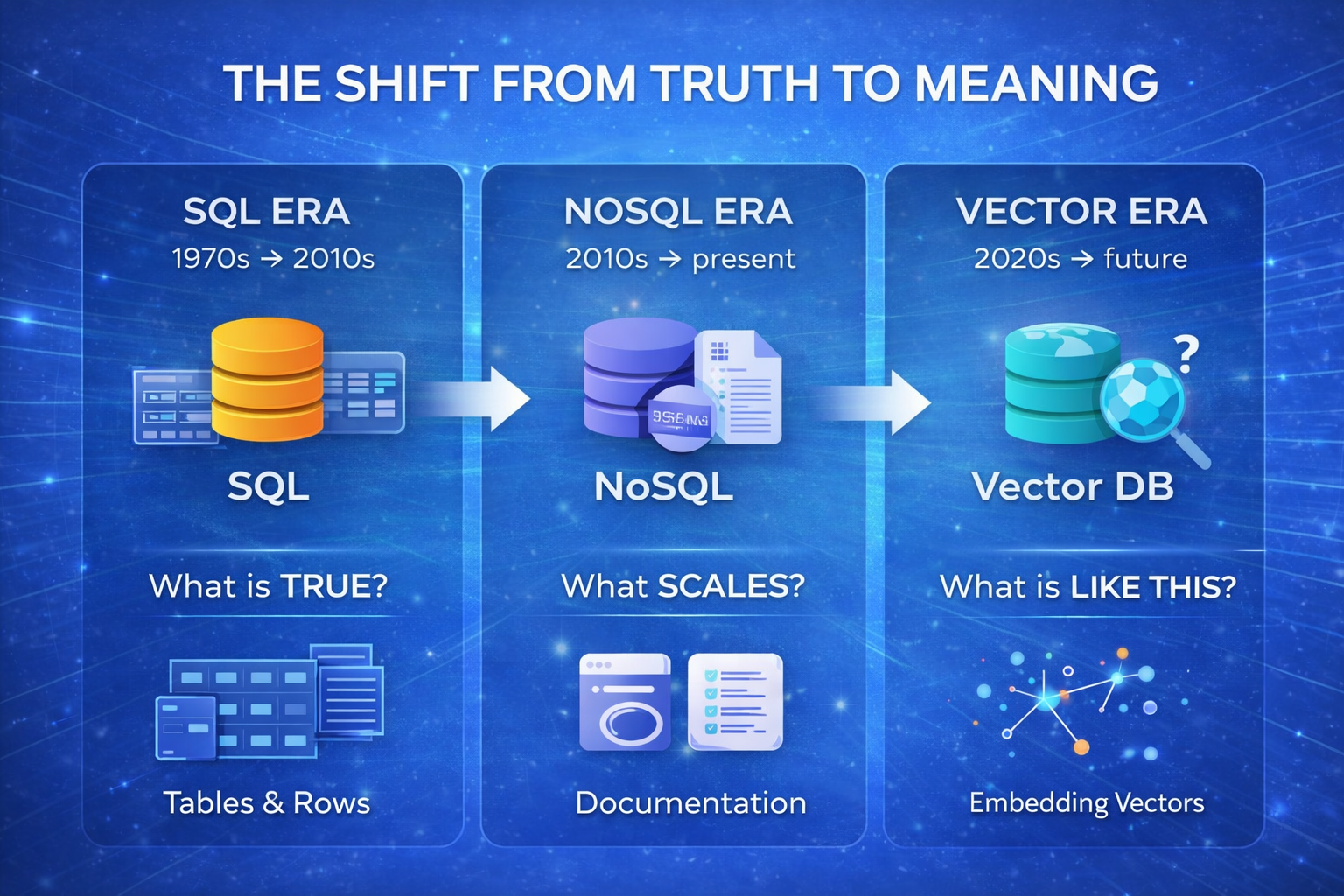
For decades, databases were designed around a single assumption: if we could structure the world precisely enough, we could understand it. This belief gave rise to SQL databases—rigid schemas, exact matches, and transactional certainty. They assumed reality could be cleanly categorized and that truth could be expressed as a row satisfying a condition.
For a long time, that assumption worked.
But the world changed.
The Shift from SQL to NoSQL: Scaling Beyond Structure
As data volumes exploded, systems began to scale beyond the comfort of centralized control. The neat tables of relational databases cracked under the pressure of global traffic, distributed systems, and unpredictable workloads.
Out of that tension emerged NoSQL databases—systems that abandoned rigid schemas in favor of flexibility, scalability, and resilience.
The central question shifted:
- SQL: Is this data correct?
- NoSQL: Can this data scale globally?
Yet even this evolution was not enough.
The Real Transformation: From Data to Meaning
The most significant shift was not in volume or velocity—it was in meaning.
Modern data is no longer primarily transactional. It is conversational, narrative, and unstructured. PDFs, emails, chat logs, policies, images, audio, and free-form text dominate modern systems.
Humans don’t think in exact matches.
They think in similarities, patterns, analogies, and intent.
When users query systems today, they are rarely asking for a record.
They are asking for understanding.
Why SQL and NoSQL Fall Short
Traditional databases were never designed to answer semantic questions:
- SQL databases cannot answer: “What is this like?”
- NoSQL databases cannot answer: “What does this resemble?”
This gap is where vector databases emerge—not as replacements, but as an entirely new semantic retrieval layer.
The Vector Database Shift: From Exactness to Approximation
Vector databases operate on a fundamentally different principle. Instead of storing facts as discrete fields, they store embeddings—numerical representations of meaning in high-dimensional space.
In a vector database:
- Two records don’t need to be identical
- They only need to be semantically close
This enables:
- Intent-based search
- Semantic similarity retrieval
- Context-aware AI systems
Relevance becomes probabilistic, not binary.
That shift is uncomfortable for deterministic systems—but unavoidable.
Because reality itself is approximate.
Vector Databases Do Not Replace SQL or NoSQL
A common misconception is that vector databases will replace SQL, just as NoSQL supposedly replaced relational systems. That narrative is incorrect and overly simplistic.
What is actually emerging is a three-layer data architecture:
The Three Database Layers
- SQL databases → truth, constraints, transactions
- NoSQL databases → scale, events, distributed state
- Vector databases → meaning, similarity, retrieval
Each layer answers a different question:
| Database Type | Core Question |
|---|---|
| SQL | Is this correct? |
| NoSQL | Where is this data and can it scale? |
| Vector DB | What is this similar to? |
Trying to replace one with another is like asking a dictionary to perform psychotherapy.
Why AI Made Vector Databases Inevitable
Large Language Models did not invent vector databases—but they exposed how necessary they are.
LLMs operate on context, not rows or documents. They require relevant information to be surfaced dynamically, based on meaning rather than keys.
Retrieval-Augmented Generation (RAG) revealed a fundamental problem:
we had vast amounts of data, but no reliable way to ask it human questions.
Vector databases solve that problem by treating meaning as a first-class concept.
Types of Vector Databases: Categories, Timeline, and Cloud Support
Major Vector Database Categories
| Category | Description |
|---|---|
| ANN Libraries | Low-level nearest-neighbor search engines |
| Hybrid Databases | Traditional databases extended with vector search |
| Pure Vector Databases | Vector-first, distributed systems |
| Managed Vector Services | Cloud-native, fully managed vector platforms |
| Embedded Vector Stores | Lightweight, developer-focused local stores |
Vector Databases — Timeline and Support
| Name | Category | Introduced | Cloud Support |
|---|---|---|---|
| FAISS | ANN Library | 2016 | Self-hosted |
| Annoy | ANN Library | 2016 | Self-hosted |
| Milvus | Pure Vector DB | 2019 | AWS, GCP, Azure |
| Pinecone | Managed Vector DB | 2019 | AWS |
| Weaviate | Pure Vector DB | 2019 | Multi-cloud |
| Qdrant | Pure Vector DB | 2021 | Multi-cloud |
| pgvector | Hybrid SQL + Vector | 2021 | AWS, Azure, GCP |
| OpenSearch | Hybrid Vector Search | 2021 | AWS |
| Azure AI Search | Managed Service | 2022 | Azure |
| Vertex AI Vector Search | Managed Service | 2022 | GCP |
| Chroma | Embedded Store | 2022 | Local |
| Redis Vector | In-Memory Vector | 2022 | Multi-cloud |
The Era We Are Entering
We are not leaving the age of SQL.
We are not abandoning NoSQL.
We are entering an era where meaning becomes queryable.
This is not a revolution driven by novelty.
It is a correction driven by reality.
And once you understand that, vector databases stop looking like hype—and start looking like inevitability.