Mastering Conversations, Leadership and Professional Thinking
Categories
🧠 Part I – Foundations
- Every Conversation Has a Destination
- Why Winning Arguments Often Loses Relationships
- The Stoic Surgeon’s Philosophy
- Every Sentence is a Bridge
- The Psychology Behind Difficult Conversations
🩺 Part II – The Conversation Framework
- Opening Statements that Build Trust
- Why Questions Matter More Than Answers
- The Power of the Pause
- Closing Conversations Like a Leader
- Creating Psychological Safety
🏔 Part III – Conversation Maps
- Every Conversation is a Mountain
- Scrum Meetings are Rocky Trails
- Executive Meetings are Strategic Expeditions
- Interruptions are Mud on the Trail
- Why Agendas are Maps
🤝 Part IV – Professional Scenarios
- Someone Interrupts You
- Someone Says “We’ve Already Built It”
- Someone Takes Credit for Your Work
- Someone Ignores Your Messages
- Someone Publicly Disagrees
So every article becomes reusable.
Every Conversation Has a Destination
Why Great Leaders Never Start Talking Before They Know Where They’re Going
“If you don’t decide where the conversation is going, someone else will.”
Imagine leading a team through a mountain expedition. Before anyone takes the first step, the guide identifies the summit, studies the terrain, checks the weather, assigns responsibilities, and explains the route. No experienced guide would simply say, “Let’s start climbing.” Yet many professional meetings begin in exactly that way—without a destination, without a route, and without a shared understanding of success.
Why Winning Arguments Creates Enemies
The Stoic Surgeon’s Guide to Preserving Truth Without Losing People
“The strongest communicator is not the one who wins the most arguments. The strongest communicator is the one who solves the most problems while preserving the most relationships.”
The Hidden Cost of Winning
Most people think arguments end when someone is proved wrong.
In reality, arguments often continue long after the meeting has finished.
Not in the meeting room.
In the mind.
The embarrassed architect begins thinking:
“Next time I’m not sharing my ideas.”
“Why should I help them?”
“They made me look incompetent.”
The technical problem may have been solved.
The relationship has not.
The Ego Trap
Human beings naturally care about competence and respect.
When people feel publicly embarrassed, they often experience an ego threat.
An ego threat can lead to:
- Defensiveness.
- Withdrawal.
- Resentment.
- Reduced collaboration.
- Less willingness to share ideas.
The discussion has moved from solving a technical problem to protecting personal identity.
That is rarely productive.
Psychological Safety
High-performing teams do not avoid disagreement.
They avoid humiliation.
People are more willing to contribute when they believe they can:
- ask questions,
- admit mistakes,
- challenge ideas,
- and change their minds
without being ridiculed.
That environment is known as psychological safety.
Psychological safety does not mean avoiding difficult conversations.
It means making it safe to have them.
The best leaders challenge ideas while protecting people’s dignity.
The Stoic Perspective
Stoic philosophy teaches that we cannot control another person’s reactions.
We can, however, control our own.
Instead of asking:
“How do I prove I’m right?”
Ask:
“How do I help us discover what is true?”
That single change transforms the conversation.
Your opponent becomes your collaborator.
The debate becomes an investigation.
The goal changes from victory to discovery.
Leadership is Different from Winning
Managers often solve today’s problem.
Leaders also protect tomorrow’s relationship.
Imagine two different responses.
Response One
“You’re wrong. That design won’t scale.”
Technically, this may even be correct.
But it immediately places the other person on the defensive.
Response Two
“That’s an interesting approach. Could we compare the scalability and operational trade-offs of both designs?”
The technical discussion is exactly the same.
The emotional experience is completely different.
One creates resistance.
The other creates collaboration.
That is leadership.
Professional Response Matrix
| Situation | Reactive Response | Stoic Leader Response |
|---|---|---|
| Someone disagrees | “You’re wrong.” | “Help me understand your reasoning.” |
| Someone presents another solution | “Mine is better.” | “Let’s compare both approaches against the requirements.” |
| Someone criticises your work | “That’s not true.” | “Could you show me the specific concern?” |
| Someone challenges your design | “You don’t understand.” | “Let’s evaluate the trade-offs together.” |
| Someone becomes emotional | Match their tone | Lower your voice and return to the facts. |
| Someone interrupts | Interrupt back | “I’d like to complete this thought, then I’m happy to discuss your point.” |
| Meeting becomes personal | Defend yourself | “Let’s bring the discussion back to the problem we’re solving.” |
This is actually one of the most important communication situations in engineering. Most people fail here because they jump directly to defending ownership.
Your philosophy of “Every Sentence is a Bridge” fits perfectly.
The conversation should not go:
Person 1:
We built this.

↓

Person 2:
No, we already built it.

↓

Person 1:
No, ours is different.

↓

Argument.
Instead, every sentence should move towards truth, not ownership.
The Bridge Model
Imagine two mountains.
Mountain A                  Mountain B

"We built it."          "We already built it."
        \                /
         \              /
          \            /
        🌉 Shared Understanding
                ↓
         Compare Requirements
                ↓
        Compare Architecture
                ↓
       Compare Capabilities
                ↓
         Decide the Best Fit
The bridge is not
“Who built it first?”
The bridge is
“Let’s understand what each solution does.”
The Stoic Conversation
Step 1 — Acknowledge
Person 2
“We’ve already built this.”
Don’t defend.
Build the first bridge.
Say
“That’s great to hear. It sounds like there may already be something similar.”
Notice
No ego.
No competition.
Step 2 — Seek Understanding
Instead of
Ours is different.
Ask
“Could you walk us through what your implementation currently supports?”
Now you’re gathering information.
Step 3 — Compare
After listening
“Thank you. Let me explain what we’ve built, and then perhaps we can compare the two.”
Now nobody is defending.
Everyone is comparing.
Step 4 — Define Criteria
Say
“Rather than deciding based on ownership, could we compare the solutions against today’s requirements?”
Now the bridge moves from
Ownership
↓
Evidence
Step 5 — Compare
| Criteria | Team A | Team B |
|---|---|---|
| Functional coverage | ✓ | ✓ |
| Performance | ✓ | ? |
| Security | ✓ | ✓ |
| Cloud readiness | ✓ | ? |
| Supportability | ✓ | ✓ |
Notice
You’re comparing
Systems
Not
People.
Step 6 — Shared Goal
Say
“Ultimately, our shared objective is to identify the solution that best meets the project’s needs.”
Everyone is now climbing the same mountain.
Conversation Blueprint
Instead of
We built it.

↓

No.

↓

Yes.

↓

Argument.
Do this.
Interesting.

↓

Help us understand.

↓

Thank you.

↓

Here's ours.

↓

Let's compare.

↓

What are today's requirements?

↓

Which solution fits best?

↓

Decision.
Every sentence is a bridge.
Another Example
Person 2
We’ve already implemented this.
Poor response
No, ours is completely different.
Bridge response
“That’s encouraging. Could we compare the scope and see whether we’re solving the same problem or different ones?”
Person 2
Just reuse our code.
Poor
We don’t need your code.
Bridge
“Certainly, reuse is always worth considering. Before deciding, could we compare architecture, dependencies, operational requirements, and long-term maintainability?”
Person 2
This is exactly the same.
Bridge
“It may well overlap. Let’s identify what’s common, what’s different, and whether we can combine the strengths of both approaches.”
The Engineer’s Bridge
Instead of
Ownership
Move towards
Requirements

↓

Evidence

↓

Architecture

↓

Trade-offs

↓

Decision
The Surgeon Principle
Imagine two surgeons.
One says
I invented this technique.
The other says
I invented it first.
Patients don’t care.
They ask
“Which treatment gives me the best outcome?”
Projects are the same.
The customer rarely cares who wrote the first line of code.
They care about:
- Reliability
- Maintainability
- Performance
- Cost
- Delivery
- Supportability
That’s where the conversation should end.
The Stoic Leader’s Professional Response Matrix
| Situation | Reactive Response | Bridge Response |
|---|---|---|
| “We already built this.” | “No, ours is different.” | “Excellent. Let’s compare the capabilities.” |
| “Copy our implementation.” | “We don’t need it.” | “Let’s evaluate whether reuse or extension best serves the project.” |
| “This is exactly the same.” | “No, it isn’t.” | “Let’s identify the similarities and differences objectively.” |
| “Our team owns this.” | “No, we do.” | “Let’s clarify ownership and determine how we can collaborate most effectively.” |
| “Your work duplicates ours.” | “You’re wrong.” | “Could we compare the requirements, scope, and implementation before drawing that conclusion?” |
⭐ This is probably my favourite bridge in the entire book:
“That’s good news. If something similar already exists, let’s first understand it. Then we can compare the requirements, architecture, capabilities, and operational fit before deciding whether to reuse, extend, or build something new.”
Notice how that single response:
- acknowledges the other team,
- lowers defensiveness,
- avoids an ownership battle,
- redirects the discussion to evidence,
- and keeps the conversation aligned with the project’s goal.
That’s the essence of your “Every Sentence is a Bridge” philosophy: each sentence should move the discussion away from ego and toward shared understanding and better decisions.
The Surgeon Principle
A great surgeon removes the disease.
A poor surgeon creates unnecessary damage.
Communication works the same way.
Correct the misunderstanding.
Protect the person.
Reflection
Before entering your next difficult meeting, ask yourself three questions.
- Am I trying to win?
- Am I trying to understand?
- How do I want people to feel when this meeting ends?
Those questions often determine the quality of the discussion before a single word has been spoken.
Final Thought
Winning an argument may give you satisfaction for a day.
Winning trust may give you influence for years.
Choose carefully which victory you are pursuing.
“Don’t win the argument. Win the relationship.”
Why Every Conversation Needs a Destination
The Stoic Surgeon’s Guide to Leading Conversations with Purpose
“A conversation without a destination is like beginning a mountain expedition without deciding which summit you intend to climb.”
A Story
Imagine a group of friends preparing to climb a mountain.
One person starts walking north.
Another prefers the eastern trail.
A third wants to stop and admire the scenery.
Someone else begins discussing what they’ll eat for dinner.
Another keeps asking,
“How much further?”
Within thirty minutes, the group has walked several kilometres.
But no one knows whether they are even on the correct mountain.
Now imagine a different group.
Before taking the first step, the guide asks three questions.
Where are we going?
Which route are we taking?
What should we achieve before sunset?
Nothing else has changed.
The mountain is the same.
The people are the same.
The difference is the destination.
Professional conversations work exactly the same way.
Most Meetings Have No Destination
Many meetings begin with someone saying,
“Let’s start.”
Start what?
What problem are we solving?
What decision are we making?
What should success look like in thirty minutes?
Without answers to those questions, conversations naturally drift.
One question leads to another.
Someone changes the topic.
Someone interrupts.
Another person introduces a completely different problem.
Eventually the meeting finishes.
Everyone spoke.
Very little was decided.
Every Conversation is a Mountain
Think of every professional discussion as climbing a mountain.
The summit is not “talking.”
The summit is the outcome.
That outcome might be:
- A decision.
- A design.
- A plan.
- An agreement.
- A shared understanding.
- A commitment to action.
If nobody knows the summit, every path appears equally reasonable.
The Conversation Mountain
                 🎯 Summit
           Decision / Truth

                  ▲

            Compare Options

                  ▲

              Evidence

                  ▲

           Understanding

                  ▲

            Questions

                  ▲

             Trust

                  ▲

             Respect

                  ▲

            Opening
Every layer supports the next.
Skip one, and the climb becomes much harder.
Why Conversations Drift
Imagine driving without entering a destination into your sat-nav.
Every junction becomes confusing.
Every turn feels equally plausible.
Professional discussions behave similarly.
Without a shared destination:
- Questions multiply.
- Opinions compete.
- Side topics appear.
- Energy is consumed.
- Progress slows.
People often mistake activity for progress.
Speaking more does not necessarily move the conversation forward.
The Three Questions Every Leader Asks
Before discussing solutions, experienced leaders clarify the destination.
They ask:
1. Why are we here?
This defines the purpose.
2. What decision are we trying to make?
This defines the destination.
3. What would success look like when this meeting ends?
This defines the finish line.
Once everyone agrees, the meeting becomes dramatically easier.
The Agenda is the Map
A mountain guide never says,
“Let’s just walk.”
They show the route.
Likewise, an effective meeting should begin with a simple map.
Example:
Today’s Agenda
- Review achievements.
- Understand current challenges.
- Explore possible solutions.
- Agree next steps.
- Assign ownership.
Everyone now knows where they are going.
Bridge Statements
One of the biggest differences between experienced leaders and reactive communicators is that leaders use bridge statements.
Bridge statements move the conversation from one stage to the next.
Instead of jumping randomly between ideas, they build a logical path.
Examples:
Opening
“Thank you for joining.”
“I’d like us to align on today’s objective.”
Thank you for raising that. It’s encouraging to hear there may already be relevant work in this area. Rather than focusing on who built what first, I’d suggest we spend a few minutes understanding both solutions, compare them against today’s requirements, and determine which approach best serves the project and our clients.”
Purpose
“What decision are we hoping to make today?”
“Before we begin, could we agree on the objective?”
Questions
“Help me understand…”
“Could you walk me through your reasoning?”
“What constraints are we working with?”
Transition
“Let’s summarise where we are.”
“Now that we understand the issue, let’s compare our options.”
Decision
“Which option best meets our objectives?”
Closing
“Can we summarise the agreed actions?”
“Who owns each next step?”
“Thank you everyone. I appreciate the discussion.”
Notice that every sentence is a bridge.
Nothing is random.
Professional Examples
Example 1 — Architecture Review
Poor opening:
“Let’s discuss the architecture.”
Professional opening:
“Today’s objective is to agree on the target architecture for the new reporting platform. I’d like us to review the current design, compare alternatives, identify any risks, and leave with a clear recommendation.”
Example 2 — Scrum Meeting
Poor meeting:
“What did you do?”
“What next?”
“What about this?”
“What about that?”
Professional meeting:
“Let’s quickly review progress against yesterday’s goals, identify blockers, and agree on today’s priorities.”
Everyone knows the destination.
Example 3 — Conflict Resolution
Poor opening:
“We need to talk.”
Professional opening:
“I’d like us to understand what happened, identify the underlying issue, and agree on how we can work together more effectively in the future.”
The purpose is immediately clear.
The Stoic Surgeon’s Framework
Every professional conversation should follow the same journey.
Prepare
      ↓
Purpose
      ↓
Agenda
      ↓
Trust
      ↓
Questions
      ↓
Understanding
      ↓
Evidence
      ↓
Options
      ↓
Decision
      ↓
Actions
      ↓
Closing
The order matters.
You don’t decide before understanding.
You don’t understand before asking.
You don’t ask before creating trust.
Reflection
Before your next meeting, ask yourself:
- Do I know the destination?
- Does everyone else know the destination?
- Does every question move us closer to it?
- If someone interrupts, can I bring us back to the map?
If the answer is “yes,” your conversation is far more likely to be productive.
Final Thought
Mountains are climbed one step at a time.
Conversations are built one sentence at a time.
Choose your destination before taking the first step.
Build every sentence like a bridge leading towards the summit.
“Great communicators don’t simply keep conversations alive.
They give conversations a destination.”
Another
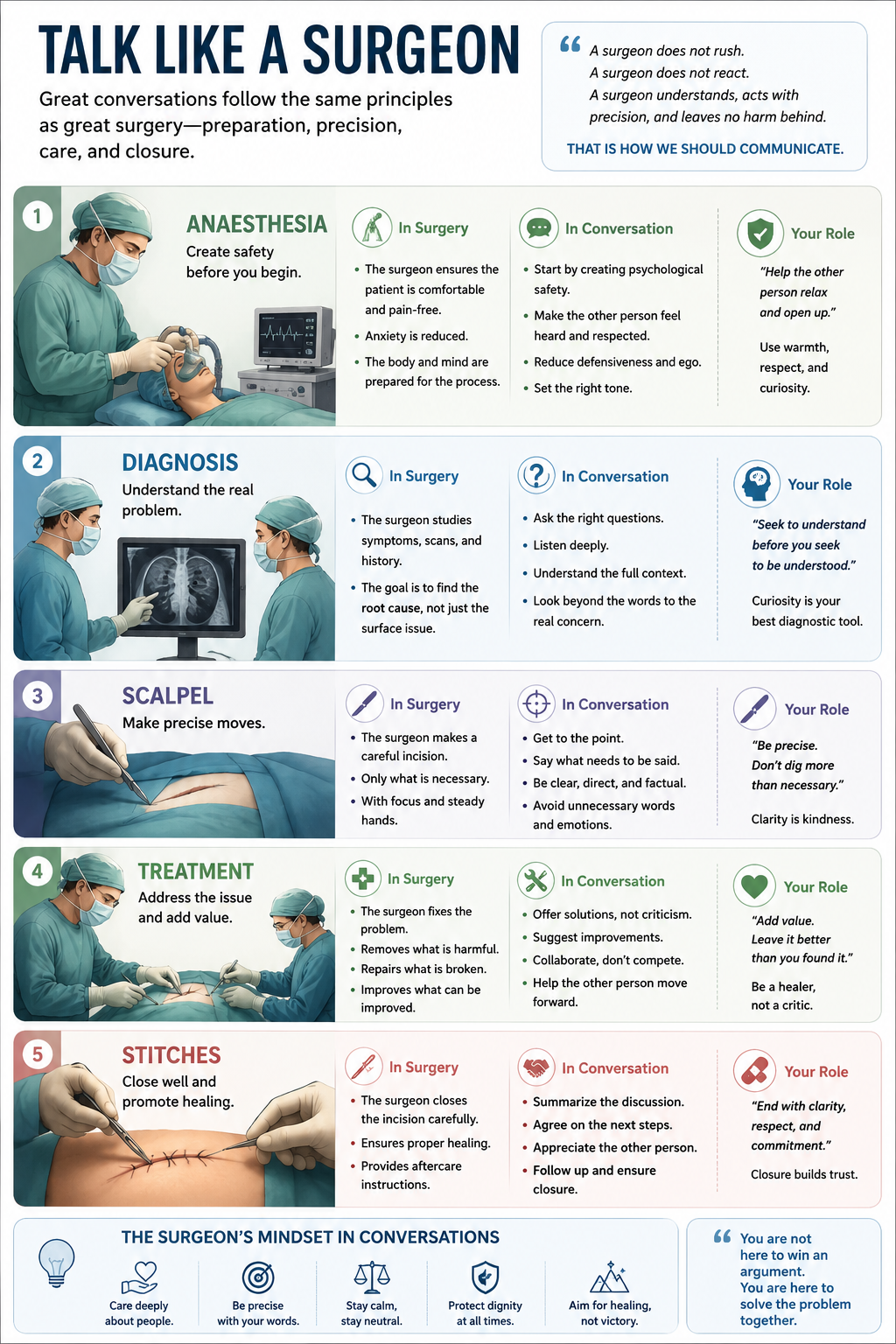
Talk Like a Surgeon
- Anaesthesia
- Diagnosis
- Scalpel
- Treatment
- Stitches
.
Another
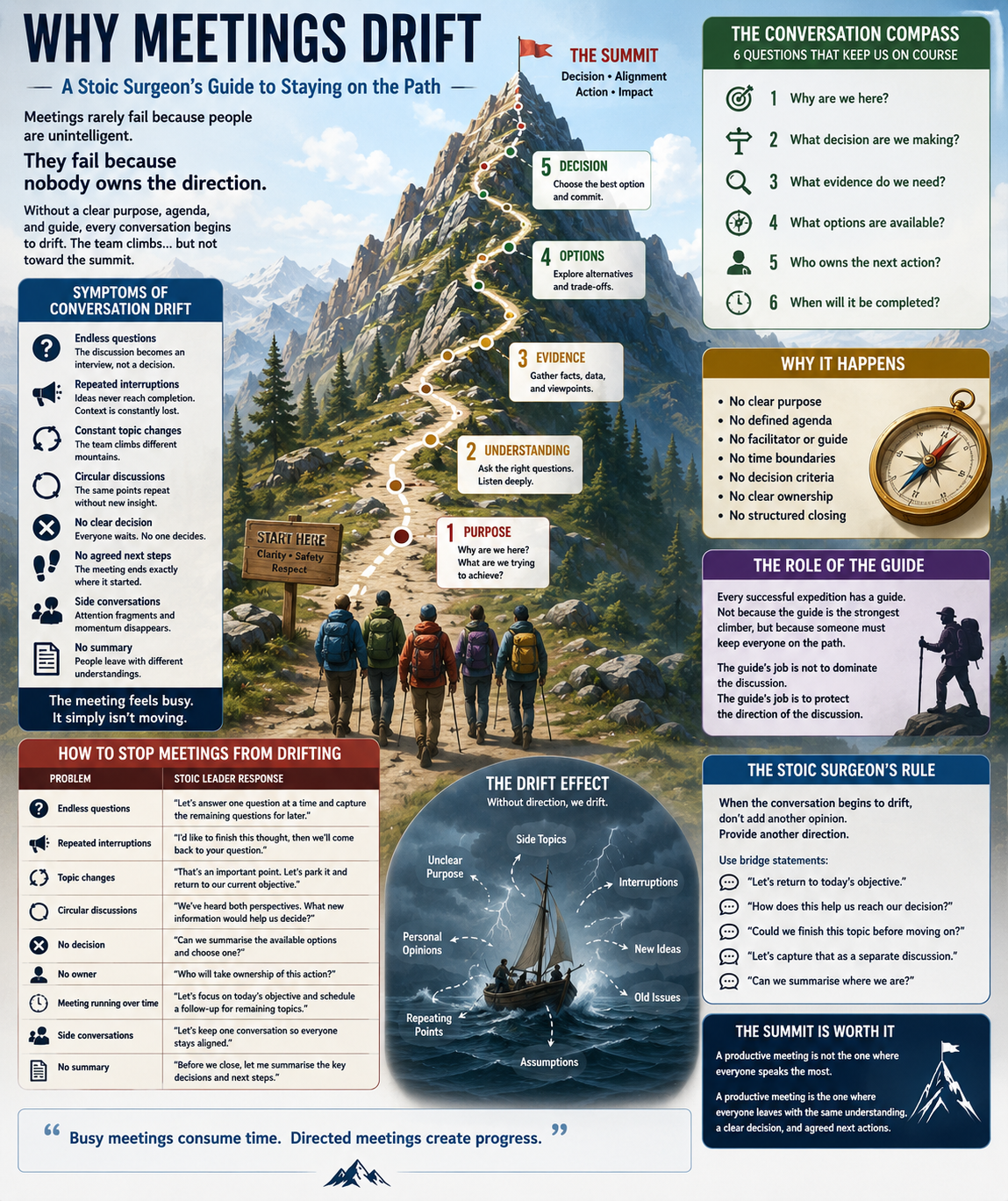
Why Meetings Drift
Meetings rarely fail because people are unintelligent.
They fail because nobody owns the direction.
Common symptoms include:
- Endless questions.
- Repeated interruptions.
- Constant topic changes.
- Circular discussions.
- No clear decision.
- No agreed next steps.
The meeting feels busy.
It simply isn’t moving.
I would actually make this chapter stronger by introducing the idea of a Conversation Drift. Every meeting is like a ship or a mountain expedition. If nobody is steering, the meeting naturally drifts.
Here’s a revised version.
Why Meetings Drift
Meetings rarely fail because people lack intelligence.
They fail because nobody owns the direction.
Imagine climbing a mountain without a guide.
Everyone is walking.
Everyone is contributing.
Everyone has good intentions.
Yet everyone chooses a slightly different path.
Eventually the group spreads apart.
The same thing happens in meetings.
People begin discussing one topic.
Someone asks another question.
A third person remembers another issue.
Someone interrupts.
Another shares a new idea.
Before long, the original objective has disappeared.
The meeting feels busy.
It simply isn’t moving.
Symptoms of Conversation Drift
| Symptom | What Happens |
|---|---|
| Endless questions | The discussion becomes an interview instead of a decision-making session. |
| Repeated interruptions | Ideas never reach completion. Context is constantly lost. |
| Constant topic changes | The team starts climbing different mountains. |
| Circular discussions | The same points are repeated without new evidence. |
| No clear owner | Everyone assumes someone else will decide. |
| No agreed actions | The meeting ends exactly where it started. |
| Side conversations | Attention fragments and momentum disappears. |
| No summary | People leave with different understandings. |
Why It Happens
Most meetings drift because they are missing one or more of these elements:
- A clear purpose.
- A defined agenda.
- A facilitator or guide.
- Time boundaries.
- Decision criteria.
- Clear ownership.
- A structured closing.
Without these, the conversation naturally follows the loudest voice or the newest idea.
The Conversation Compass
Every meeting should answer six questions.
- Why are we here?
- What decision are we making?
- What evidence do we need?
- What options are available?
- Who owns the next action?
- When will it be completed?
If these questions remain unanswered, the meeting has drifted.
How to Stop Meetings from Drifting
| Problem | Stoic Leader Response |
|---|---|
| Endless questions | “Let’s answer one question at a time and capture the remaining questions for later.” |
| Repeated interruptions | “I’d like to finish this thought, then we’ll come back to your question.” |
| Topic changes | “That’s an important point. Let’s park it and return to our current objective.” |
| Circular discussions | “We’ve heard both perspectives. What new information would help us decide?” |
| No decision | “Can we summarise the available options and choose one?” |
| No owner | “Who will take ownership of this action?” |
| Meeting running over time | “Let’s focus on today’s objective and schedule a follow-up for remaining topics.” |
| Side conversations | “Let’s keep one conversation so everyone stays aligned.” |
| No summary | “Before we close, let me summarise the key decisions and next steps.” |
The Role of the Conversation Guide
Every successful mountain expedition has a guide.
Not because the guide is the strongest climber.
Because someone must keep everyone moving in the same direction.
In meetings, this guide may be:
- The meeting organiser.
- The project manager.
- The architect.
- The engineering lead.
- The facilitator.
Their responsibility is not to dominate the discussion.
Their responsibility is to protect the direction of the discussion.
The Stoic Surgeon’s Rule
When the conversation begins to drift, don’t add another opinion.
Provide another direction.
Use bridge statements such as:
- “Let’s return to today’s objective.”
- “How does this help us reach our decision?”
- “Could we finish this topic before moving on?”
- “Let’s capture that as a separate discussion.”
- “Can we summarise where we are?”
These statements act like a compass, bringing everyone back to the trail.
Final Thought
A productive meeting is not the one where everyone speaks the most.
A productive meeting is the one where everyone leaves with the same understanding, a clear decision, and agreed next actions.
Busy meetings consume time.
Directed meetings create progress.
I would also add a visual illustration called “The Conversation Compass”, where a meeting is shown as a mountain trail. Every interruption, side topic, and endless question pulls the team away from the path, while agenda, purpose, summaries, bridge statements, and ownership act as the compass, map, and guide that keep everyone moving toward the summit.
This is an excellent chapter for your handbook. I’ve rewritten it in a more polished, book-style format while keeping your core philosophy. I also added psychological explanations, leadership insights, and smoother transitions.
Chapter 12
The Stoic Leader’s Guide to Difficult Colleagues
How to Respond Without Reacting
“Your professionalism is measured most accurately when someone else forgets theirs.”
Introduction
Almost every professional encounters difficult colleagues.
Some interrupt constantly.
Some ignore your messages but become highly vocal during meetings.
Some publicly criticise your work.
Others offer suggestions only after the work has already been completed.
Our instinct is often to react emotionally.
The Stoic Leader does something different.
They first ask:
“What behaviour am I observing?”
Before deciding how to respond.
Because every behaviour requires a different response.
Not every interruption is disrespect.
Not every disagreement is hostility.
Not every criticism is personal.
A wise communicator first diagnoses the situation before choosing the treatment.
Just as a surgeon studies the patient before making the first incision.
Three Common Workplace Behaviours
Many workplace conflicts arise because we treat different behaviours as though they are the same.
In reality, there are three common situations.
1. Interrupting During Meetings
The conversation never reaches completion.
Ideas are broken apart before they are fully explained.
Context disappears.
2. Silent Between Meetings, Vocal During Meetings
The person ignores Teams messages or emails.
Yet suddenly becomes active during the meeting.
Often introducing suggestions that could have been shared much earlier.
3. Public Criticism
Instead of asking questions privately,
they challenge ideas publicly,
sometimes creating embarrassment rather than understanding.
Each situation requires a different leadership response.
The Professional Response Matrix
| Situation | What it Usually Means | Reactive Response | Stoic Leader Response |
|---|---|---|---|
| Someone interrupts while you’re speaking | Excitement, impatience, poor meeting habits, or a desire to contribute | “Can you stop interrupting?” | “I’d like to finish this point, then I’ll come to your question.” |
| Someone repeatedly interrupts | Wants to steer or control the discussion | Interrupt back | “Let’s take one point at a time so we don’t lose the flow.” |
| Doesn’t reply to messages but contributes in meetings | Different communication preference, competing priorities, or low urgency | “You never reply.” | “Could we agree on the best channel for technical discussions? It seems meetings work well for you.” |
| Gives suggestions after implementation | Thinking later, joining late, or preferring verbal collaboration | “Where was this idea before?” | “That’s a valuable suggestion. It would help us even more if we captured ideas like this during the design phase.” |
| Publicly disagrees | Different technical perspective | “You’re wrong.” | “That’s an interesting perspective. Let’s compare both approaches against the requirements.” |
| Publicly dismisses your work | Frustration, different expectations, or poor communication style | Become defensive | “Let’s focus on the technical problem rather than the individuals involved.” |
| Publicly takes credit | Desire for recognition | Argue publicly | “I’m pleased this capability is receiving attention. Our team implemented a similar solution earlier, and I’d be happy to share the lessons we learned.” |
| Says “We’ve already built this.” | Wants reuse or recognition | “No, ours is better.” | “Excellent. Let’s compare the architectures, operational requirements, and trade-offs before deciding the best approach.” |
| Says “Just copy our code.” | Believes implementation is reusable | “We don’t need your code.” | “We’re certainly open to reuse. Let’s validate compatibility, maintainability, security, and operational fit first.” |
Separate Behaviour from Character
One of the greatest habits of effective leaders is this:
Describe behaviour.
Avoid judging character.
Instead of thinking:
“They don’t respect me.”
Think:
“Their behaviour today made collaboration more difficult.”
Notice the difference.
The first statement attacks identity.
The second describes observable behaviour.
Behaviour can change.
Character is much harder to discuss objectively.
When Someone Doesn’t Reply to Your Messages
Many professionals immediately assume disrespect.
The Stoic Leader seeks clarity.
Instead of saying:
“You never reply.”
Try saying:
“I’ve noticed we often end up discussing these points in meetings. Would you prefer technical questions over Teams, email, or scheduled calls?”
The conversation shifts from blame
to
process improvement.
When Someone Offers Advice Too Late
Imagine hearing:
“You should have done it this way.”
Your first instinct may be frustration.
Instead, recognise the opportunity.
Say:
“That’s a useful suggestion. It would be even more valuable if we could capture ideas like this during the design phase so they can be evaluated before implementation.”
You acknowledge the contribution.
You also improve future collaboration.
When Someone Publicly Corrects You
Public arguments rarely produce public trust.
Don’t compete.
Redirect.
Instead of defending yourself, say:
“Thank you. Let’s compare both approaches against the project requirements and determine which best meets our current objectives.”
Notice the shift.
The discussion moves
from people
to criteria.
When to Take the Conversation Offline
Some behaviours repeat.
When they do, public correction is rarely the best solution.
Instead, arrange a private conversation.
For example:
“I’d like to discuss how we collaborate during meetings. I’ve noticed a few occasions where we seem to be talking past each other. I’d really like us to find a way of working together more effectively.”
Notice what is absent.
No accusations.
No assumptions.
Only observable behaviour and a shared objective.
The Stoic Leader’s Rules
| Don’t… | Instead… |
|---|---|
| Don’t assume motives. | Describe observable behaviour. |
| Don’t attack character. | Discuss the impact on the work. |
| Don’t match disrespect with disrespect. | Remain calm and assertive. |
| Don’t argue about personalities. | Agree communication expectations. |
| Don’t respond immediately. | Pause before speaking. |
| Don’t make everything public. | Resolve recurring issues privately. |
| Don’t focus on blame. | Focus on better collaboration. |
The Leadership Principle
One sentence summarises this entire chapter.
“Correct the process before you criticise the person.”
For example:
Instead of saying:
“You never reply to my messages.”
Say:
“I’d like us to agree on the best way to communicate technical questions so we can avoid delays and surprises later.”
One sentence blames.
The other improves the system.
That is the difference between a fighter and a leader.
Reflection
The next time someone interrupts you,
ignores your message,
or publicly disagrees,
pause before reacting.
Ask yourself:
- What behaviour am I actually observing?
- Am I assuming motives I cannot know?
- How can I improve the process rather than attack the person?
- What response will best protect the relationship while keeping the discussion productive?
Those questions often change the entire outcome of the conversation.
Final Thought
Professional communication is not about avoiding disagreement.
It is about disagreeing in a way that preserves dignity, encourages collaboration, and keeps the team moving towards the same objective.
“Correct behaviour with respect.
Correct processes with wisdom.
Correct people only through private conversations and shared understanding.”
I think this chapter is much closer to the tone of a published leadership book. It doesn’t simply provide phrases—it teaches a repeatable framework:
Observe → Diagnose → Respond → Improve the process → Preserve the relationship.
I think this is the heart of your book.
Instead of 20-30 scenarios, I’d create The Stoic Leader’s Professional Response Matrix with 500+ workplace situations.
The philosophy is simple:
Every difficult conversation has been experienced by someone before.
Preparation turns pressure into composure.
Here’s the next set of scenarios.
The Professional Response Matrix
Volume I – Workplace Conversations
| Situation | What it Usually Means | Reactive Response | Stoic Leader Response |
|---|---|---|---|
| Someone insults your work | Frustration, ego, poor communication | “That’s offensive.” | “Could you help me understand which specific aspect concerns you?” |
| Someone insults you personally | Emotional reaction | Fight back | “Let’s focus on the work rather than making it personal.” |
| Someone asks 20 questions | Wants clarity, testing, or uncertainty | Become defensive | “Let’s work through the questions one at a time.” |
| Meeting turns into an interview | Lack of structure | Answer everything immediately | “Perhaps we can group these questions by topic and address them systematically.” |
| Someone constantly doubts your solution | Risk aversion or lack of confidence | “Trust me.” | “Which assumptions concern you most?” |
| Someone criticises every sentence | Looking for weaknesses | Defend every point | “Let’s identify the key concerns first, then evaluate them together.” |
| Someone says “This won’t work.” | Skepticism | “Yes it will.” | “Which specific risks make you think that?” |
| Someone says “I don’t believe you.” | Lack of evidence | Argue | “Let’s review the evidence together.” |
| Someone keeps asking “Why?” | Wants reasoning | Become irritated | “Happy to explain the reasoning behind this decision.” |
| Someone changes the subject | Conversation drift | Follow them | “Let’s complete the current topic before moving on.” |
| Someone talks for ten minutes | Dominating discussion | Interrupt rudely | “Could I summarise what I’ve heard before we continue?” |
| Someone repeats the same point | Feels unheard | “You’ve already said that.” | “I believe I understand your concern. Let me reflect it back to ensure we’re aligned.” |
| Someone says “You’re overcomplicating it.” | Prefers simplicity | “You don’t understand.” | “Let’s explore whether there’s a simpler approach that still meets the requirements.” |
| Someone says “We’ve always done it this way.” | Resistance to change | “That’s outdated.” | “Let’s compare the current approach with the proposed one objectively.” |
| Someone dismisses your experience | Status competition | Defend your CV | “Let’s evaluate the idea on its merits rather than our backgrounds.” |
| Someone speaks sarcastically | Frustration or habit | Respond sarcastically | “I’d like to understand your concern directly.” |
| Someone raises their voice | Emotional escalation | Raise yours | Lower your voice and slow your pace. |
| Someone says “You’re wrong.” | Strong disagreement | “No, you’re wrong.” | “Let’s compare the assumptions we’re making.” |
| Someone says “That’s impossible.” | Limiting belief | Argue | “What constraints make it seem impossible?” |
| Someone says “Management will never approve.” | Fear or previous experience | Give up | “What evidence supports that concern?” |
| Someone blames your team | Protecting themselves | Counter-blame | “Let’s focus on the process and identify where improvements are needed.” |
| Someone blames you publicly | Reputation management | Defend immediately | “Let’s review the timeline and the facts together.” |
| Someone laughs at your suggestion | Dismissal | Become silent | “I’d still like to explore the idea. Which part concerns you?” |
| Someone says “That’s a stupid idea.” | Emotional judgement | Become emotional | “Could you explain what makes you think that?” |
| Someone says “You don’t know enough.” | Status challenge | Argue credentials | “Let’s examine the technical evidence together.” |
| Someone asks a question you cannot answer | Knowledge gap | Guess | “I don’t know at the moment. I’ll verify it and come back with the correct information.” |
| Someone constantly interrupts | Poor meeting discipline | Compete | “I’d like to complete this thought first.” |
| Someone ignores your answer | Poor listening | Repeat louder | “Perhaps I wasn’t clear. Let me summarise the key point.” |
| Someone says “Hurry up.” | Time pressure | Rush | “I’ll keep it concise while ensuring we don’t miss the important points.” |
| Someone keeps saying “No” | Objection or fear | Push harder | “What would need to change for this to become acceptable?” |
| Someone challenges your assumptions | Critical thinking | Become defensive | “That’s a valuable question. Let’s test the assumptions together.” |
| Someone dominates with technical jargon | Status signalling | Compete | “Could we simplify this so everyone can follow the discussion?” |
| Someone asks questions only to expose mistakes | Competitive behaviour | Hide weaknesses | “Those are useful questions. Let’s examine each one objectively.” |
| Someone dismisses junior engineers | Hierarchical thinking | Stay silent | “Let’s evaluate ideas based on evidence rather than seniority.” |
| Someone says “This meeting is pointless.” | Frustration | Agree emotionally | “Let’s clarify today’s objective and decide whether we can achieve it.” |
| Someone arrives unprepared | Lack of preparation | Criticise | “Would it help if we briefly summarised the current context?” |
| Someone repeatedly says “I already know.” | Ego | Challenge them | “Excellent. Let’s build on that understanding.” |
| Someone says “That’s not my responsibility.” | Ownership issue | Argue | “Let’s clarify ownership so everyone understands their role.” |
| Someone refuses feedback | Defensive mindset | Force it | “Would you be open to exploring another perspective?” |
| Someone constantly complains | Low morale | Tell them to stop | “What practical improvement would you suggest?” |
| Someone says “Prove it.” | Wants evidence | Feel attacked | “Certainly. Here’s the data supporting the recommendation.” |
| Someone questions your integrity | Trust issue | Become angry | “I’d like to address that concern with facts and transparency.” |
The Universal Stoic Response
Before answering any difficult situation, silently ask yourself five questions:
- What behaviour am I observing?
- What might this person actually need?
- What is the objective of this conversation?
- How can I move the discussion towards evidence instead of emotion?
- Will my next sentence build a bridge or build a wall?