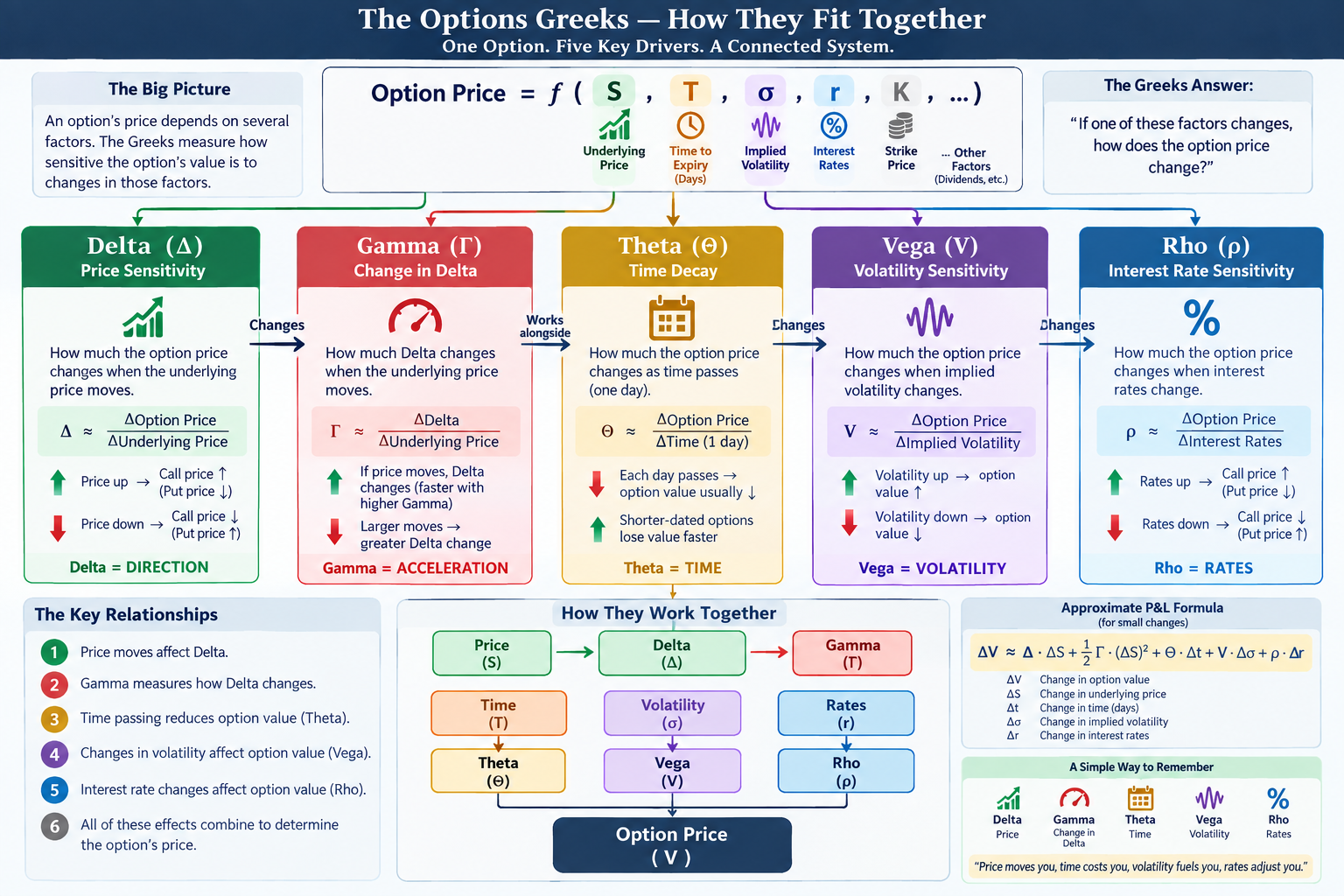
Options can appear rather intimidating at first.
Terms such as Delta, Gamma, Theta, implied volatility, volatility skew and Black–Scholes have a habit of making the subject sound considerably more mysterious than it needs to be.
Yet the central idea is surprisingly straightforward.
An option is a financial contract whose value depends on something else. Once we understand what that underlying asset is, what rights the contract provides, what determines its price, and how that price responds to changing market conditions, the Greeks begin to look far less exotic.
This guide develops that understanding gradually — from basic derivatives through to options pricing, volatility, the Greeks, hedging and professional options trading.
1. Derivatives: Starting from First Principles
A derivative is a financial contract whose value is derived from another asset or financial variable.
That reference is known as the underlying.
The underlying might be:
- a share;
- an equity index;
- a currency;
- gold or another commodity;
- an interest rate; or
- another financial instrument.
Suppose, for example, that we have an option written on a share trading at £100.
The option has its own market price, but that price depends partly upon what happens to the £100 share.
Hence:
Underlying asset → Derivative value
This relationship is the foundation upon which the rest of derivatives trading is built.
Spot Price
The spot price is broadly the current market price of an asset for immediate transaction.
If gold is trading at $2,500 per ounce, $2,500 is approximately its current spot price.
Derivatives, by contrast, often concern what might happen in the future.
2. Forwards, Futures and Options
There are several important types of derivatives.
Forward Contracts
A forward contract is an agreement between two parties to buy or sell an asset at a predetermined price on a future date.
Forwards are commonly traded over the counter (OTC) and can therefore be customised to suit the counterparties.
Futures Contracts
A futures contract has a similar economic idea, but futures are generally standardised and traded through organised exchanges.
They are widely used for both hedging and speculation.
Options
Options introduce an important difference.
An option gives the buyer a right, but not an obligation, to buy or sell the underlying according to specified contractual terms.
The buyer pays a price for that right.
That price is called the option premium.
This distinction is fundamental:
Future → contractual obligations
Option buyer → contractual right
3. Calls and Puts
There are two fundamental types of options.
Call Option
A call option gives its buyer the right to buy the underlying at a predetermined price.
Suppose:
Share price = £100
Call strike = £105
If the share subsequently rises substantially above £105, the right to buy at £105 may become valuable.
A long call is therefore generally a bullish position.
Put Option
A put option gives its buyer the right to sell the underlying at a predetermined price.
Suppose:
Share price = £100
Put strike = £95
If the share falls dramatically, the right to sell at £95 may become valuable.
A long put is therefore generally a bearish position.
A useful starting memory is:
Call → Right to BUY
Put → Right to SELL
4. Strike, Expiry and Premium
Three pieces of information appear repeatedly in options trading.
Strike Price
The strike price is the predetermined price associated with the option’s exercise right.
For example:
Underlying = £100
Call strike = £105
The option provides the contractual right to buy at £105.
Expiry
Options do not normally exist indefinitely.
They have an expiry date.
This matters enormously because an option with six months remaining has considerably more opportunity for favourable market movements than one with only a few hours remaining.
Time itself therefore has economic value.
Option Premium
The premium is the market price of the option.
Suppose an option costs:
£4 per share
and one contract represents 100 shares.
The premium paid would be:
£4 × 100 = £400
before transaction costs.
This £400 buys the contractual right provided by the option.
5. Option Buyers and Writers
Every option transaction has two sides.
The buyer, or holder, purchases the right.
The seller, often called the writer, receives the premium and assumes the corresponding contractual obligation.
This produces an important asymmetry.
For a plain long option, the buyer’s direct loss is generally limited to the premium paid.
An option writer can face considerably greater losses.
An uncovered short call, for example, has theoretically unlimited loss potential because there is theoretically no ceiling on how high the underlying share price can rise.
This is one reason options should never be understood merely as inexpensive alternatives to buying shares.
Their risk structures are fundamentally different.
6. ITM, ATM and OTM
Options are frequently described according to their moneyness.
In-the-Money — ITM
An option is in-the-money when it possesses positive intrinsic value.
For calls:
Spot > Strike
For puts:
Spot < Strike
At-the-Money — ATM
An option is approximately at-the-money when the strike is close to the current underlying price.
For example:
Share ≈ £100
Strike = £100
Out-of-the-Money — OTM
An option is out-of-the-money when it currently possesses no intrinsic value.
For calls:
Spot < Strike
For puts:
Spot > Strike
Moneyness becomes particularly important when we begin examining the Greeks.
7. Intrinsic Value and Time Value
An option’s premium can be thought of, in simplified terms, as:
Option Premium = Intrinsic Value + Time Value
For a call:
Intrinsic Value = max(Spot − Strike, 0)
For a put:
Intrinsic Value = max(Strike − Spot, 0)
Suppose a call has:
Strike = £100
Share price = £110
Its intrinsic value is:
£110 − £100 = £10
But imagine the option itself trades for £13.
The remaining £3 reflects additional value beyond immediate exercise value — commonly referred to as time value.
Why would anybody pay it?
Because the option has not yet expired.
The underlying might move further.
Uncertainty has value.
And that brings us naturally to volatility.
8. Volatility: The Heart of Options Trading
Volatility describes the magnitude and variability of price movements.
Consider two shares.
Share A
£100 → £101 → £99 → £101 → £100
Share B
£100 → £120 → £87 → £115 → £90
Share B is considerably more volatile.
This matters to options because greater potential movement creates greater possibilities for option payoffs.
Historical and Realised Volatility
Historical volatility is calculated from past price movements.
Realised volatility refers to volatility that actually occurred over a particular period.
Both concern observed movement.
Implied Volatility
Implied volatility (IV) is different.
It is the volatility level implied by current option prices when interpreted through an option-pricing framework.
This distinction is worth remembering:
Realised volatility → What actually happened
Implied volatility → What current option prices imply
A trader might therefore form a view not simply about whether a share will rise or fall, but about whether future realised volatility will be greater or smaller than the volatility currently priced into options.
That is a much more sophisticated trading question.
9. Volatility Smile, Skew and Surface
Real markets are more complicated than assuming one volatility number for every option.
Options with different strikes frequently have different implied volatilities.
Plot those implied volatilities against strikes and we may observe a volatility smile or volatility skew.
Add different expiry dates and we obtain another dimension.
We can then think of:
Strike × Expiry × Implied Volatility
This produces the volatility surface.
For professional derivatives traders, the volatility surface is enormously important because an options portfolio may contain many strikes and maturities simultaneously.
10. Enter the Greeks
We have now reached the part that often frightens beginners unnecessarily.
An option’s value depends upon several variables.
Conceptually:
Option Value = f(Underlying Price, Time, Volatility, Interest Rates, …)
The Greeks simply measure sensitivities.
They answer questions such as:
- What happens if the underlying moves?
- What happens as time passes?
- What happens if implied volatility changes?
- What happens if interest rates change?
There are five Greeks every options student should understand first.
11. Delta — Sensitivity to Price
Delta (Δ) measures an option’s sensitivity to a small movement in the underlying price, all else equal.
Suppose a call has:
Delta = 0.60
If the underlying rises by approximately £1, the option might rise by approximately:
£1 × 0.60 = £0.60
for a sufficiently small movement and with other variables held constant.
Delta therefore answers:
How sensitive is my option to the underlying price?
A useful memory:
Delta → PRICE
12. Gamma — The Movement of Delta
There is a complication.
Delta itself changes.
Suppose your call currently has:
Delta = 0.50
As the underlying moves, perhaps Delta becomes:
0.50 → 0.55 → 0.61 → 0.68
What measures this change?
Gamma (Γ).
Gamma measures the sensitivity of Delta to changes in the underlying.
A useful way to think about it is:
Price changes → Delta changes
Gamma measures that Delta change
Or simply:
Gamma → DELTA’S SENSITIVITY
13. Theta — The Cost of Time
Imagine buying an option with three months remaining.
Every day that passes leaves slightly less time for a favourable movement to occur.
Theta (Θ) measures an option’s sensitivity to the passage of time under the relevant pricing convention.
Long options commonly have negative Theta.
This leads to one of the great peculiarities of options trading:
You can be correct about the eventual direction of the market and still lose money.
If the move happens too slowly, time decay may work against the position.
Remember:
Theta → TIME
14. Vega — Sensitivity to Volatility
Vega measures an option’s sensitivity to implied volatility.
Suppose you own an option.
The underlying barely moves, but suddenly the market expects enormous uncertainty.
Implied volatility rises sharply.
The option can increase in value even though the underlying has hardly moved.
Why?
Because greater uncertainty increases the potential range of future outcomes.
Remember:
Vega → VOLATILITY
15. Rho — Sensitivity to Interest Rates
Rho (ρ) measures an option’s sensitivity to interest rates.
Its importance varies depending upon the product and maturity.
For many short-dated equity options, traders may spend considerably more time thinking about Delta, Gamma, Theta and Vega.
For longer-dated derivatives and rate-sensitive structures, interest-rate effects can become much more significant.
Remember:
Rho → INTEREST RATES
16. The Greeks in One Picture
The five principal Greeks can now be organised neatly:
| Greek | Main Sensitivity |
|---|---|
| Delta (Δ) | Underlying price |
| Gamma (Γ) | Change in Delta |
| Theta (Θ) | Passage of time |
| Vega | Implied volatility |
| Rho (ρ) | Interest rates |
The mental model is:
Underlying Price → Delta → Gamma
Time → Theta
Volatility → Vega
Interest Rates → Rho
Once this relationship is understood, memorising the Greeks becomes largely unnecessary.
17. Delta Hedging
Suppose an options portfolio has a total:
Delta = +500
The portfolio has substantial positive directional exposure.
A trader might sell an appropriate quantity of the underlying to reduce the net Delta.
If the resulting portfolio has approximately:
Net Delta ≈ 0
it is described as delta neutral.
This does not mean risk has disappeared.
The portfolio may still possess:
Gamma risk
Vega risk
Theta exposure
and numerous other risks.
Furthermore, because Delta changes as markets move, the hedge may need to be adjusted repeatedly.
This is dynamic hedging.
18. Gamma and Theta: An Important Relationship
One of the most interesting relationships in options is between Gamma and Theta.
A long option position commonly provides:
Positive Gamma
but:
Negative Theta
In plain English:
You may benefit from sufficiently large market movement, but you pay for the privilege as time passes.
This is why options trading is not simply about predicting direction.
You may need to predict:
Direction + Magnitude + Timing + Volatility
That is a much richer problem.
19. Black–Scholes and Option Pricing
The Black–Scholes model provides a mathematical framework for valuing certain European-style options under a set of assumptions.
Important inputs include:
Spot Price
Strike Price
Time to Expiry
Volatility
Interest Rate
and, depending on formulation, dividends or other carry considerations.
Black–Scholes is important not merely because it generates an option value.
It also provides a framework from which many Greeks can be derived.
Alongside it, students should understand:
- no-arbitrage;
- put–call parity;
- risk-neutral valuation;
- the binomial model;
- European options;
- American options; and
- early exercise.
These ideas form the bridge between trading options and quantitative finance.
20. Common Options Strategies
Once individual calls and puts are understood, they can be combined.
A Covered Call combines ownership of an underlying asset with a short call.
A Protective Put combines an underlying position with a long put to provide downside protection.
A Bull Call Spread uses calls to create a limited-risk, limited-reward bullish position.
A Bear Put Spread does something similar for a bearish view.
A Straddle combines a call and put with the same strike and expiry and can benefit from a sufficiently large move in either direction.
A Strangle uses different strikes and similarly expresses a view on substantial movement.
More sophisticated structures include:
- Butterfly spreads;
- Iron Butterflies;
- Iron Condors;
- Calendar spreads;
- Diagonal spreads; and
- Ratio spreads.
The important lesson is that options allow us to trade much more than simply:
Up or Down
We can construct positions around:
Direction
Volatility
Time
Ranges
Tail risk
and combinations of these exposures.
21. Beyond the Basic Greeks
Professional derivatives books introduce a rather colourful collection of higher-order Greeks.
These include:
Vanna — interaction between underlying price and volatility sensitivities.
Vomma/Volga — sensitivity of Vega to changes in volatility.
Charm — how Delta changes as time passes.
Speed — how Gamma changes as the underlying moves.
Zomma — how Gamma changes as volatility changes.
There is little benefit in rushing into these.
If Delta, Gamma, Theta and Vega are not intuitive, memorising Vanna and Vomma merely creates an impressive vocabulary without a useful mental model.
Master the first-order structure first.
22. Professional Options Trading
Real options trading introduces practical considerations that theoretical examples can easily hide.
A trader must understand the option chain, containing strikes, expiries, bid and ask prices, volume, open interest and often implied volatility.
They must consider liquidity.
An option might appear attractively priced, but an enormous bid–ask spread can make entering and exiting expensive.
Other practical risks include:
Assignment risk — particularly when options have been sold.
Exercise mechanics — understanding what actually happens when contractual rights are exercised.
Margin — collateral requirements for certain positions.
Pin risk — uncertainty when the underlying finishes close to a strike around expiry.
Gap risk — abrupt movements between trading periods.
Event risk — earnings announcements, central-bank decisions and other events capable of moving both prices and volatility sharply.
This is where textbook options become real financial positions.
23. P&L Attribution: Understanding Why You Made Money
A professional trader should not be satisfied merely knowing:
“I made £10,000 today.”
The more useful question is:
“Why did I make £10,000?”
Options P&L can conceptually be decomposed into contributions from different risks:
P&L ≈ Delta Effect + Gamma Effect + Theta Effect + Vega Effect + Other Effects
Perhaps the underlying moved favourably.
That is largely directional exposure.
Perhaps implied volatility increased.
Vega may have contributed.
Perhaps very little happened and another day passed.
Theta may have cost money.
This way of thinking transforms the Greeks from abstract mathematics into tools for explaining actual trading performance.
24. The Complete Options Mental Model
The entire subject can now be reduced to a logical chain:
Derivative
↓
Underlying Asset
↓
Call / Put
↓
Strike + Expiry + Premium
↓
ITM / ATM / OTM
↓
Intrinsic Value + Time Value
↓
Volatility
↓
Option Pricing
↓
Delta + Gamma + Theta + Vega + Rho
↓
Hedging
↓
Options Strategies
↓
Portfolio Risk
↓
Professional Derivatives Trading
Final Thoughts
The greatest mistake when learning options is to treat them simply as leveraged bets on whether a share will rise or fall.
They are considerably more interesting than that.
An option has several moving dimensions.
The underlying price can change.
Time passes whether we like it or not.
Expectations of volatility change.
Interest rates move.
And, crucially, the option’s sensitivity to these variables changes as well.
That is why the Greeks matter.
Delta tells us about price.
Gamma tells us how Delta changes.
Theta tells us about time.
Vega tells us about volatility.
Rho tells us about interest rates.
Once these relationships become intuitive, options cease to look like an intimidating collection of Greek letters.
They become what they really are: a structured language for describing, pricing and managing financial risk.
Yes. This is actually the most important way to learn the Greeks: not as five separate definitions, but as a connected system.
The Greeks as One System
Start with an option price:\[ V = f(S,t,\sigma,r,\ldots) \]
where:
- \(V\) = option value
- \(S\) = stock/underlying price
- \(t\) = time
- \(\sigma\) = volatility
- \(r\) = interest rate
The Greeks simply ask:
If one of these things changes, what happens to my option?
The relationship looks like this:
                   OPTION VALUE
                       │
        ┌──────────────┼──────────────┐
        │              │              │
     PRICE           TIME         VOLATILITY       RATES
       │               │              │              │
     Delta           Theta           Vega            Rho
       │
     Gamma
       │
 Changes Delta
1. Delta — Price Exposure
Delta tells you how much the option price changes when the underlying moves.
Suppose:
Stock = £100
Call = £5
Delta = 0.50
If the stock rises approximately £1:\[ \Delta V \approx 0.50\times £1=£0.50 \]
So the option might move approximately:
£5.00 → £5.50
But here comes the important question:
Does Delta remain 0.50?
No.
That brings us to Gamma.
2. Gamma Changes Delta
Gamma measures how Delta changes when the underlying changes.
Suppose:\[ Delta=0.50 \]
and\[ Gamma=0.05 \]
If the stock rises by roughly £1, Delta might move approximately:\[ 0.50 \rightarrow 0.55 \]
Another £1 move might make it roughly:\[ 0.55 \rightarrow 0.60 \]
So the relationship is:
Stock Price → Delta → Gamma
More precisely:
Delta measures the option’s slope with respect to the underlying; Gamma measures how that slope changes.
This is why Delta is not constant.
3. Theta — Time Is Working at the Same Time
While the stock is moving, time is also passing.
Suppose you bought an option for £5 and:\[ Theta=-0.10 \]
Very loosely, under the quoted convention and holding other variables constant, one day’s passage might reduce its theoretical value by about £0.10.
So even if the stock does nothing:
£5.00 → approximately £4.90
This explains something very important about options.
You can correctly predict:
“This stock will rise.”
and still lose money.
Perhaps it rises too slowly and the positive Delta effect isn’t sufficient to overcome Theta and other changes.
4. Vega — Volatility Changes the Equation
Now imagine the stock hasn’t moved much, but suddenly the market expects a major announcement.
Implied volatility rises.
If you own an option with positive Vega, its value can increase.
Suppose:\[ Vega=0.20 \]
If implied volatility rises by one volatility percentage point, under a common quoting convention:\[ Option\ value\ change\approx +£0.20 \]
So:
Higher IV → Long option may become more valuable
Lower IV → Long option may become less valuable
This is why you can sometimes predict the direction correctly and still lose money after an earnings announcement.
For example:
Stock ↑
Good for your call’s Delta
but simultaneously:
IV ↓↓
Bad for its Vega
and:
Time passes
Bad for its Theta
Your actual P&L reflects all these effects together.
5. Rho — Interest Rates
Finally, interest rates affect option valuation.
Rho measures this sensitivity.
For standard equity options, broadly:
Rates ↑ → Call value tends to ↑
Rates ↑ → Put value tends to ↓
all else equal.
For very short-dated options, Rho may be relatively small compared with Delta, Gamma, Theta and Vega.
For long-dated derivatives, rates can become considerably more important.
Now Connect All Five
Suppose you buy a call option:
Stock = £100
Option = £5
And imagine its Greeks are approximately:
| Greek | Value | Meaning |
|---|---|---|
| Delta | +0.50 | Price exposure |
| Gamma | +0.05 | Delta changes as stock moves |
| Theta | −0.10 | Time passage hurts |
| Vega | +0.20 | Higher IV helps |
| Rho | +0.05 | Higher rates help |
Now several things happen simultaneously.
The stock rises.
→ Delta makes money
Because the stock moved:
→ Gamma changes your Delta
A day passes:
→ Theta costs money
Implied volatility increases:
→ Vega makes money
Interest rates move:
→ Rho contributes
Therefore your option P&L isn’t simply:\[ P\&L=Stock\ movement \]
It’s more like:\[ \boxed{ P\&L \approx Delta + Gamma + Theta + Vega + Rho +\text{other effects} } \]
More mathematically, for small changes:\[ \Delta V \approx \Delta\,\Delta S + \frac12\Gamma(\Delta S)^2 + \Theta\,\Delta t + Vega\,\Delta\sigma + Rho\,\Delta r \]
This equation is worth remembering.
The Particularly Important Relationship: Gamma vs Theta
This is one of the most interesting relationships in options.
When you buy options, you commonly have:
Positive Gamma
but
Negative Theta
In simple terms:
You benefit from sufficiently large movement, but you pay for waiting.
Imagine the market doesn’t move.
Your Gamma isn’t doing much for you.
But:
Tick… tick… tick…
Theta continues working against the long option.
Now imagine the market suddenly moves dramatically.
Gamma becomes valuable because your Delta changes favourably as the underlying moves.
This creates the famous tension:
Long options
+ Gamma
− Theta
You are effectively paying time decay for convex exposure to movement.
Delta and Gamma Are Particularly Close
Think of driving a car.
Stock price movement = movement of the car
Delta = speed
Gamma = acceleration
Delta tells you how sensitive the option currently is.
Gamma tells you how quickly that sensitivity changes.
So:\[ \boxed{Gamma = \text{change in Delta}} \]
Vega and Gamma Also Have a Conceptual Connection
Higher expected volatility means the underlying is expected to have a wider range of possible future outcomes.
That can make optionality more valuable.
Therefore long options are commonly:
Positive Vega
and:
Positive Gamma
So long optionality often gives you:
+ Gamma
+ Vega
− Theta
That combination is extremely useful to remember.
A Better Mental Model
Instead of memorising five Greek definitions, picture the life of your option:
                    OPTION
                       │
         ┌─────────────┼─────────────┐
         ↓             ↓             ↓
     Stock moves    Time passes    IV changes
         │             │             │
       DELTA          THETA          VEGA
         │
       GAMMA
   changes Delta

                 Rates change
                       │
                      RHO
And remember this sentence:
Delta tells me where I am exposed; Gamma tells me how that exposure changes; Theta tells me what time costs me; Vega tells me what volatility does to me; and Rho tells me what interest rates do to me.
Once we reach option strategies, these relationships become even more useful because a portfolio can be deliberately designed to be, for example, Delta-neutral, Gamma-positive, Theta-negative and Vega-positive.
link of a ebook
http://www.machineintellegence.com/wp-content/uploads/2026/09/Basic-Option-Trading-E-Book-Hinglish-1.pdf-2.zip